On the one hand, all the pregnancy-related items are of course very important – but they’re not particularly illuminating on a list like this. If there was a “Testicular Torsion” item marked as 100% male, that wouldn’t really tell me much here either.
I imagine pregnancy-related admissions weren’t excluded because they eclipse everything else in magnitude. Surely if 1.6 million British males had been admitted for testicular torsion, you would find that illuminating.
That does appear to be the case. Almost all of the pregnancy visits aren’t done in hospital. They are clinic visits and clinical post hospital appointments. And almost all of the male admissions are trauma admissions through the ER.
And to be honest, men do have a higher rate of trauma admissions than women. While women are a bit more often admitted for medical issues. But, often have medical issues they also see a doctor for.
I disagree. It does show the contrast of what most women deal with when compared directly to the male category. And while pregnancy is specific to female (at birth), it is culturally significant because it is so prevalent.
Yes of course, that’s why I said it was important. But this table is about gender disparities in specific reasons for admittance. If the ratio can’t possibly be anything but 100%, what does that tell me about anything other than the self-evidently obvious?
You might as well tell me water is wet or the sky blue. Very true and both those facts are important, but neither is exactly new or surprising information.
I suppose it tells you that there is no male equivalent. I do think it’s interesting that there are so many fewer types of admission skewed toward women that fit the criteria of being skewed by 80% or more, especially when you consider the prominence of pregnancy related types.
I do also think it would be more interesting to see something like the top 15 admission types for men and top 15 for women without the 80% threshold requirement to get a wider spread of women-skewed admissions.
It doesn’t compare directly to the male category because there is no male category listed.
Quite a bit of interesting information on display to be sure, but with 20% of the chart displaying information that excludes one of the two things being compared, it’s not a good representation of what the title suggests.
On a chart showing male female disparity for types of cancer, ovarian and testicular would be just as irrelevant as the bottom fifth of this admissions chart.
This is why I hate this whole issue. For decades we use male and man and female and woman interchangeably. But now theres all sorts of people just waiting to pounce with “Well, actually…”. And then, if you do say male, its fine. But if you say female, you get “Oh, look. Another incel saying female!!”.
Seems like its not about communicating effectively, and more about just shitting all over things people say for worthless internet points. We all know what you meant. And it was a good point. But here we are, side stepping into this mess instead of staying focused on your point. Its all just so silly.
I mean, I know the difference between sex and gender in the English language but didn’t know this also relates to male and man (if this is what it is about as the downvotes suggest)

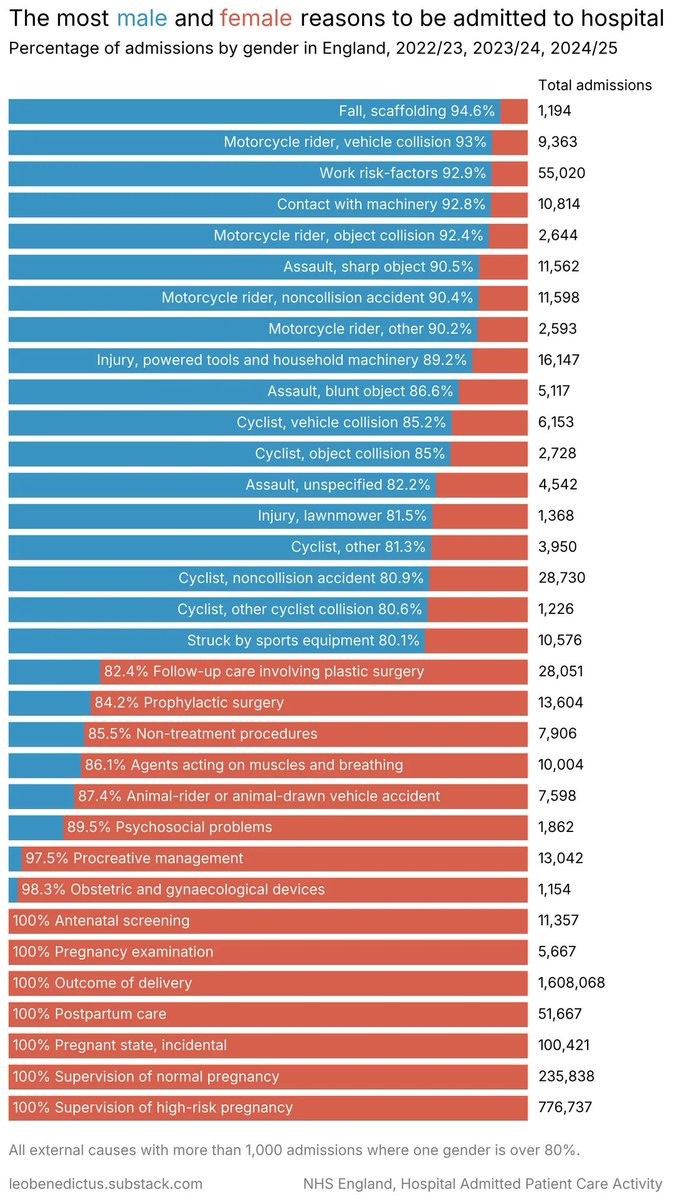
On the one hand, all the pregnancy-related items are of course very important – but they’re not particularly illuminating on a list like this. If there was a “Testicular Torsion” item marked as 100% male, that wouldn’t really tell me much here either.
I imagine pregnancy-related admissions weren’t excluded because they eclipse everything else in magnitude. Surely if 1.6 million British males had been admitted for testicular torsion, you would find that illuminating.
That does appear to be the case. Almost all of the pregnancy visits aren’t done in hospital. They are clinic visits and clinical post hospital appointments. And almost all of the male admissions are trauma admissions through the ER.
And to be honest, men do have a higher rate of trauma admissions than women. While women are a bit more often admitted for medical issues. But, often have medical issues they also see a doctor for.
I disagree. It does show the contrast of what most women deal with when compared directly to the male category. And while pregnancy is specific to female (at birth), it is culturally significant because it is so prevalent.
Yes of course, that’s why I said it was important. But this table is about gender disparities in specific reasons for admittance. If the ratio can’t possibly be anything but 100%, what does that tell me about anything other than the self-evidently obvious?
You might as well tell me water is wet or the sky blue. Very true and both those facts are important, but neither is exactly new or surprising information.
I guess it depends on what the chart is made to convey
The chart does include total admissions for each. Category, so you can compare the numbers across categories, I guess.
I suppose it tells you that there is no male equivalent. I do think it’s interesting that there are so many fewer types of admission skewed toward women that fit the criteria of being skewed by 80% or more, especially when you consider the prominence of pregnancy related types.
I do also think it would be more interesting to see something like the top 15 admission types for men and top 15 for women without the 80% threshold requirement to get a wider spread of women-skewed admissions.
It doesn’t compare directly to the male category because there is no male category listed.
Quite a bit of interesting information on display to be sure, but with 20% of the chart displaying information that excludes one of the two things being compared, it’s not a good representation of what the title suggests.
On a chart showing male female disparity for types of cancer, ovarian and testicular would be just as irrelevant as the bottom fifth of this admissions chart.
I am a bit confused. Do you mean they purposely grouped stuff to make it seem like a bigger issue than the cancers you mention?
Uh oh
Yes, yes. Entirely legitimate issues about gender identity aside, I think we all know my point here is strictly about biology.
This is why I hate this whole issue. For decades we use male and man and female and woman interchangeably. But now theres all sorts of people just waiting to pounce with “Well, actually…”. And then, if you do say male, its fine. But if you say female, you get “Oh, look. Another incel saying female!!”.
Seems like its not about communicating effectively, and more about just shitting all over things people say for worthless internet points. We all know what you meant. And it was a good point. But here we are, side stepping into this mess instead of staying focused on your point. Its all just so silly.
lol I have you tagged as “gets it” and you keep living up to that.
… there is a difference between man and male?
deleted by creator
I mean, I know the difference between sex and gender in the English language but didn’t know this also relates to male and man (if this is what it is about as the downvotes suggest)
deleted by creator
God forbid someone who doesn’t natively speak English doesn’t know the nuance between these words that are often not used “properly”
Yeah this is a super pointless list because it’s obvious they cherry picked data points to make the graph look dramatic.