

cross-posted from: https://lemmy.world/post/46293279
From Parklane Landscapes
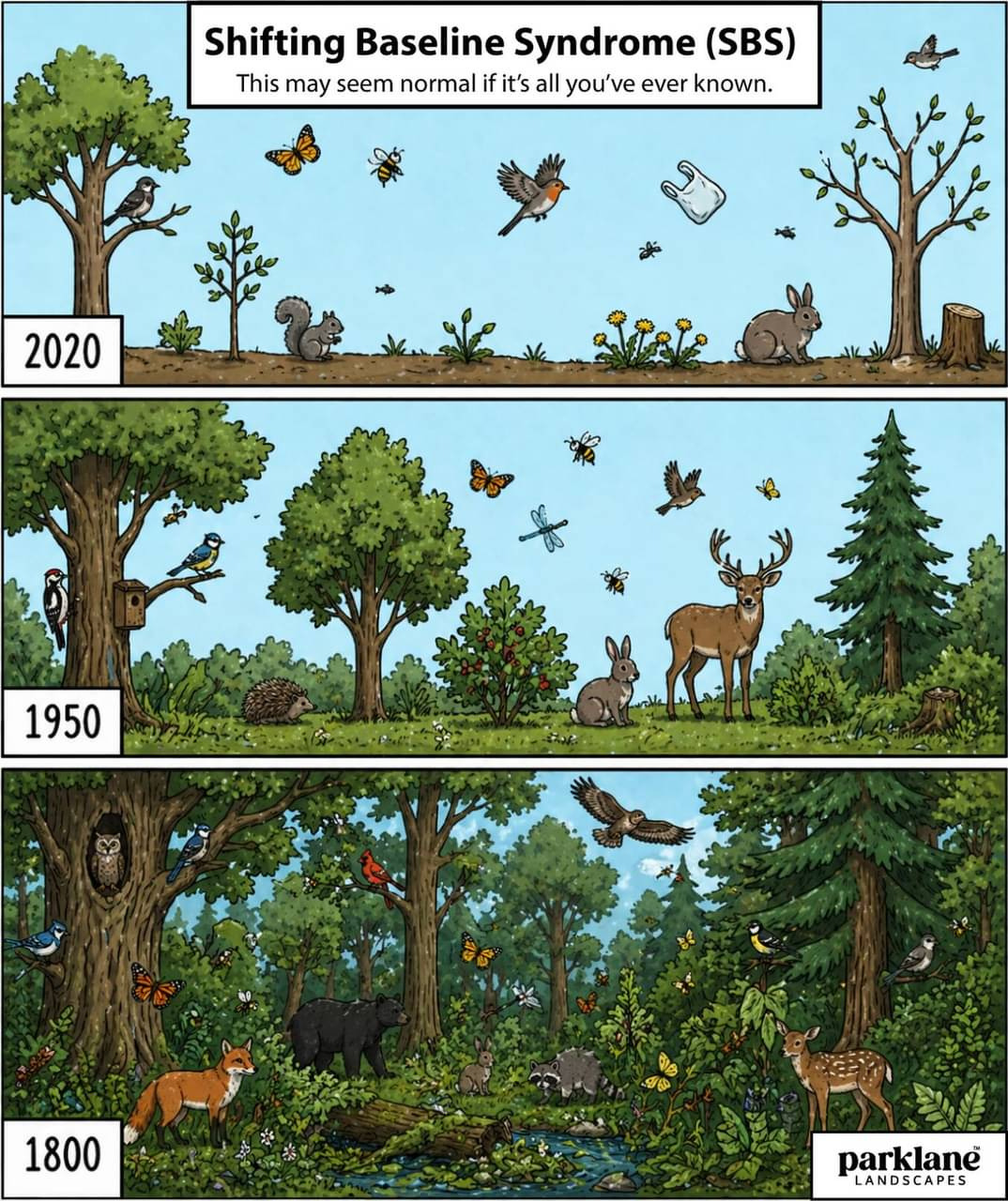
Shifting Baseline Syndrome (SBS) is what happens when we forget how vibrant the natural world used to be. Each generation grows up with a more depleted environment and calls it “normal,” simply because it’s all they’ve ever known.
Think about walking through a park and thinking, “This seems healthy.” But maybe 30 years ago that same park had twice as many birds, wildflowers, or insects. If you never saw that version, you don’t feel the loss - and that quiet forgetting becomes the new baseline. Over time, we start accepting degraded ecosystems as normal.
Researchers warn that this shift lowers our expectations, increases our tolerance for decline, and reduces our urgency to protect what’s left.
What helps:
Intergenerational conversations that reconnect us with what nature used to be.
Direct experiences with nature that sharpen our awareness of change.
Remembering (knowing) the past is the first step to restoring the future.
Not a sponsor, I don’t think it’s an AI graphic, and I think it has something important to say. Plus it does have an owl. We can’t save our animals if we don’t save them the spaces they need to thrive.
Just a quick reminder; this is not true for western central europe. Deforestation in the area of Germany had already 2000 years ago been a problem. Germany currently has much more forest area than it had for example 500 years ago.
Forests are not necessarily the most diverse and natural ecosystem in certain regions. When you go back time with a similar climate to today and no humans, you would have had straight tusk elephants, some of the largest the world has ever seen in what is today Germany. Add to that Irish elk, which 4.5m from bottom to the top of the antlers tall and European forms of lions, leopards and rhinos.
These species would have kept Germany a much more open landscape, with some forested areas, but still open grassland. That is why a lot of native species require open grassland to survive. For example the bustard does not live in forests, but so do many insects. They often survived thanks to pastures keeping land somewhat open.
That is also true for many other parts of the world. Forests are not always ideal.
A large percentage of those forests are monocultures grown for the paper, pulp, timber and cellulose industry. According to Global Forest Watch, in 2020 9% of land cover on Germany was natural forests but 15% was non-natural. It’s basically not very different from planting a field of corn.
Sadly a bunch of trees does not a forest make, especially if they’re not native. Most of the local wildlife will not be able to benefit from those trees for food, and there needs to be diversity in types of plants beyond just trees.
Yeah, just like a lawn isn’t nature. It’s a bit better (e. g. against floods?) than concrete but not good.
Forest is not the same as tree plantations.
Yes, but Germany now has more actual forest than it did 200 years ago, too. Or 20 years ago. Or 20000 years ago ;p