A friend and I are arguing over ghosts.
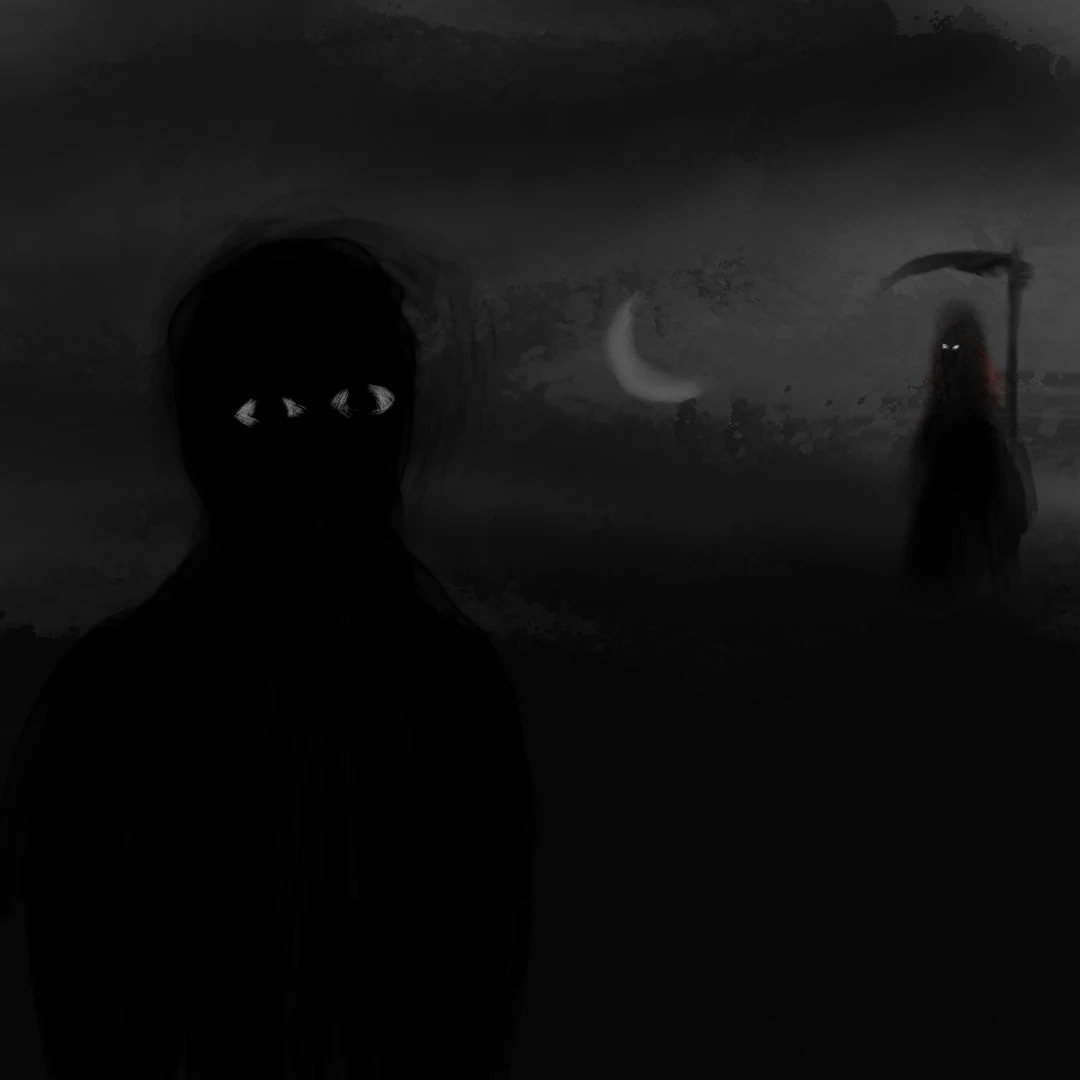
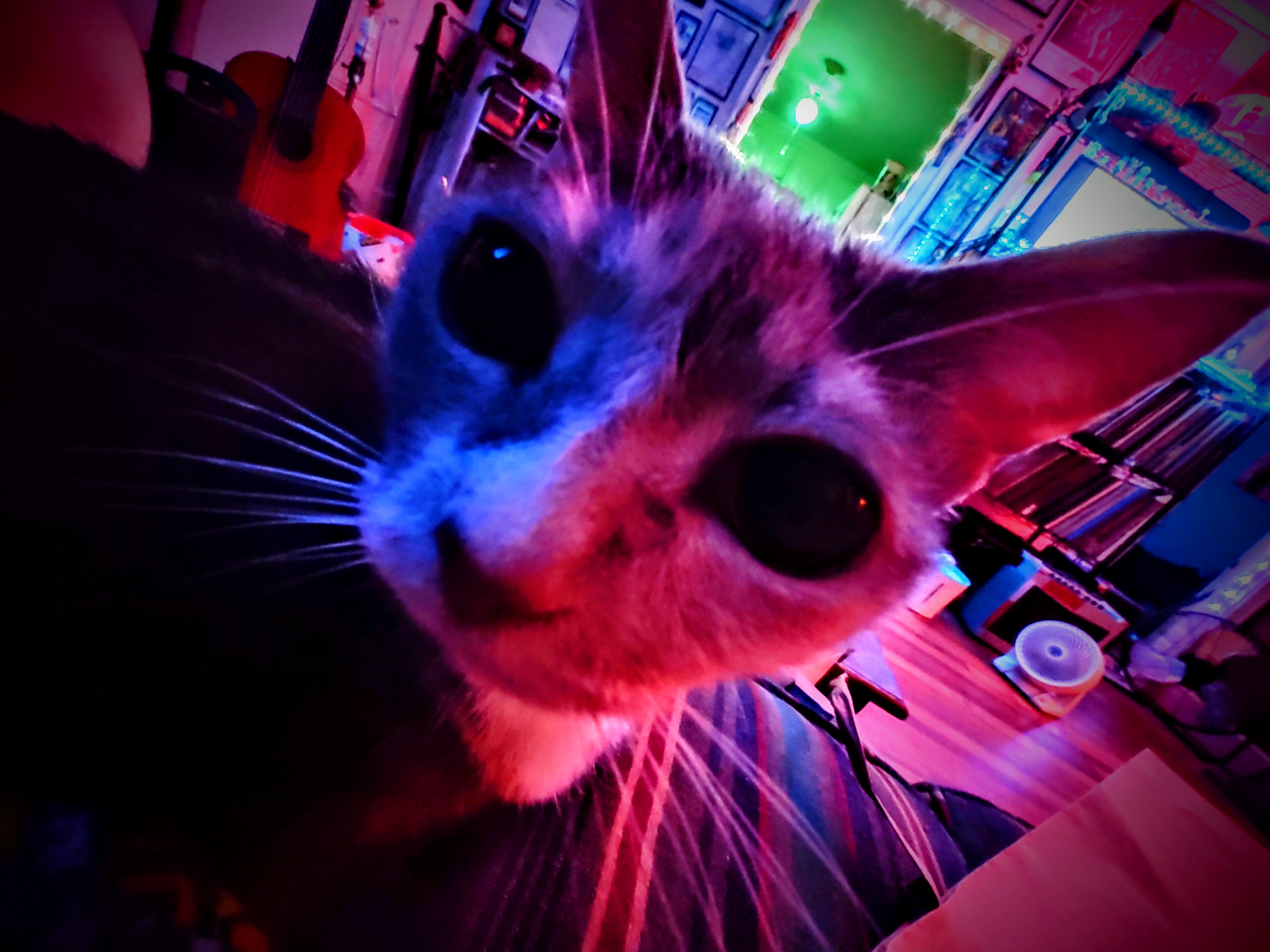
I think it’s akin to astrology, homeopathy and palm reading. He says there’s “convincing “ evidence for its existence. He also took up company time to make a meme to illustrate our relative positions. (See image)
(To be fair, I’m also on the clock right now)
What do you think?
@[email protected] @[email protected]
I’m someone who’s quite used to try and see things through the lens of Science. I’m a nerd, after all. But I’ve also been, especially since 2023 (when I momentarily was part of a Luciferian group), someone who does actual ritualistic practices, I’m quite religious.
I don’t really believe in ghosts in the typical (e.g. kardecist) sense, partly because I want to believe that death can dissolve the ego once and for all. I mean, hell no!, I’m not going to reincarnate again, Demiurge can go pound sand.
However, in a nutshell, I believe in two things.
First, the thing we call “spiritual” would be some kind of actual, spatial dimension, a field/brane (as in M-theory); “spirit” is just non-baryonic matter which, similarly to neutrinos, have very weak, almost undetectable, interaction with ordinary matter (maybe spirits are neutrinos, who knows?); and everything, from living beings to asteroids, all made of “star stuff” (to quote Carl Sagan), would have simultaneous “spirit stuff”. I’d be “pan-animist” (i.e. everything got a spirit).
The other part of my belief: dæmons, entities, archons, Demiurge… And, most importantly, The Dark Mother. I believe in their existences as cosmic principles. For dæmons, entities and archons, I believe they’re analogous to living beings (self-organizing structures) but baryonically incorporeal, some of them knowledgeable about interacting with this baryonic realm.
For Demiurge (popularly known as “God”) and the Dark Mother Goddess (often unbeknownst to those who believe in “God” because patriarchy tried to erase Her from human knowledge), they’re both… ineffable, I don’t even know how to start making scientific sense of both, they’re manifestation of several laws of physics themselves.
Goddess, specifically: She’s the entropy, She’s the field across which EM radiation propagates, She’s in the silence, She’s the singularity and the event horizon and She’s also the black hole; mainly, She’s Darkness. She’s Death Herself. We’re wired to see Darkness and Death as “evil”, what to flee from, but I came to the conclusion that good and evil are nothing but artificial human constructs, and when one detaches themselves from mundane measurements, Demiurge is actually the closest to “evil” because he traps the matter into this existence, distancing us from our true origin, the Mother and Her Womb. Death is Mother trying to rescue us; life, reincarnation (Samsara), is Demiurge trying to keep us trapped in this theater. A cosmic tug of war.
Like fractals, they both unfold within their Wholes: Sefirots emanated from Demiurge, Qlippots from Mother, Goetia dæmons as mixed emanations.
Both also unfold into Great Manifestations as rebellious complementarities: Lucifer (from Demiurge) and Lilith (from Dark Mother Goddess). I’ve experienced them manifesting physically many times like “ghosts” would do, particularly Lilith, whom I directly worship.
Dunno how “reasonable” I am, tho.
Are you able to provide specific evidence that ghosts AREN’T real?
Never imaged
Never measured
Never captured
Never seen by people without mental health issues.
Can you prove there isn’t a teapot in orbit around the moon?
Russell’s Teapot orbits the sun. There isn’t room in this solar system for two orbiting teapots.
Prove it!
There might be for all I know!
Their point is that one could come up with a billion hypotheticals for what might theoretically exist, because we cannot disprove it. If we spent as much time humming and hawing whether each one actually does exist as we do for ghosts, souls, gods, Big Foot etc., then you won’t be doing anything else in life.
That’s why it’s a typical position to just say that they don’t exist until proven otherwise.Or in the more general sense, this is Occam’s Razor: If there’s multiple possible explanations for something, then one should assume the simplest explanation until proven otherwise.
And if you hear a door slamming shut in your house, then wind is a much simpler explanation than ghosts.
yes.
the utter lack of convincing evidence that ghosts are real is evidence that ghosts are not real.
An utter lack of evidence thus far
and I’m sure you’re the one who is going to find the evidence.
it is not as though humanity hasn’t been looking for evidence of the supernatural since… well… probably before hommo sapiens were a thing…
Nope.
Reason on its own doesn’t bring enough to the table. Without critical thinking (and even with it) reason can lead to any conclusion.
If the data you reason on is flawed (and it is for everyone) then you’ll end up with wrong conclusions no matter how reasonable you are.
The only evidence is anecdotal, there just happens to be a lot of it.
So no, I’d say it’s unreasonable to believe in ghosts. (Though I do love ghost stories and folklore.)
It’s not important that you believe in ghosts. It’s only important that they believe in themselves.
Real? Who cares? It’s fun!
Well, we care. That’s why I asked. It’s just that some people are certain about they position on this and refuse to back it up.
And of course it’s fun, I’ll happily suspend belief for 90 minutes to allow me to be creeped out by a good ghost movie, but that ends when the credits start rolling.
I mean, it sounds like your friend genuinely doesn’t understand the scientific method. That doesn’t necessarily make them unreasonable. It just means they had a sub-standard science education.
He’s wishy washy on the scientific method, not because he doesn’t understand it but because he believes it’s wrong (or at least incomplete)
We’ve spoken about this on several occasions and either his arguments make no sense or I’m genuinely too dumb to get them.
Arguments against it typically make no sense.
deleted by creator
That’s essentially a “god of the gaps” argument, i.e. if we cannot demonstrate it scientifically, therefore it must be God, or ghosts, or the Great Bacterial Collective Intelligence. But, in any case, turn that question around: do we have good reason to scientifically exclude the possibility of ghosts? And the answer there is a very strong ‘yes’.
Ryan North has a lot of Dinosaur Comics exploring concepts around ghosts, but the one that sticks in my mind is the one in which T-Rex muses about finding out what makes a poltergeist angry, triggering its ire constantly, and connecting the object(s) it manipulates to a generator in order to get infinite free energy.
Because, the physical world that we know and inhabit works on energy. For a ghost to interact with our world, it would simply have to inject energy into it. Sound, light, heat, et cetera, it’s energy. There’s no way around it. And we have laws of physics, like conservation of energy, which we very, very, very thoroughly tested at the scale, energy level, and relativistic velocities (that is, our human environment) at which ghosts would interact. In our natural world, we’d have to see macroscopic effects without causes, and energy entering or leaving the system. We’d be able to measure it, but we have not. E = mv2, and the two sides of the equation balance, always.
More prosaically, another Dinosaur Comics strip posits that ghosts must be blind because they’re invisible. Invisibility means that all light passes through them, but if it doesn’t strike whatever ghosts use for photoreceptors, they’d by needs be blind. If their eyes did intercept light so that they were able to see, then if a ghost was watching you in a bright room, you’d at least see the faint shadows of its retinas. (Creepy!) In short, we don’t have to make any claims about the supernatural to say that if ghosts, or other supernatural phenomenon, interact with our natural world, we’d have to be able to see and measure the effect beyond subjective reports. However, we don’t, and there really just aren’t any gaps in the physics for ghosts to reside in.
As for the book, well, we all live inside these meat-based processors that are not exactly reliable in interpreting sensory input, or making narrative sense of it, and are well-known to just fabricate experiences and memories out of the ether when the sensory input is absent, scrambled, or just not interesting enough. It seems to me that the strongest likelihood is that brains did what brains habitually do (i.e. come up with fantastical stories), and that our theory of physics is pretty decent, since it has enabled us to create all sorts of technology.
deleted by creator
With all due respect, you’ve latched onto 1. my introductory literary device for framing the argument, and 2. where I dismiss the book based on my argument, but missed my argument, which I would succinctly state as: By definition, we don’t know anything about the supernatural, but we know the natural world extremely well, and we can explain the way that it behaves fully and completely without supernatural influence. Not only do we lack evidence of the supernatural, the evidence that we do have rules it out.
deleted by creator
The details here might be a bit out of scope for a c/nostupidquestions thread but I’m basing my thoughts here on the book Surviving Death by Leslie Kane.
What was it that convinced you?
deleted by creator
Dude…no one fact checks those books and bullshit sells.
No one buys a book that says nothing happens when you die.
No one comes back from clinical death unless the medical staff fucked up.
Near death experiences are a tricky thing to study. There are physiological explanations for much of it, such as weird brain activity is likely to be interpreted as a weird experience.
These people would have no way of having knowing this stuff unless they’ve seen it for themselves, which would have been physically impossible.
The problem of this argument is confirmation bias. An anecdote of seeing information you couldn’t have seen and being right is going to be more memorable than seeing information and being wrong.
when you have several hundred of them compiled back-to-back-to-back it becomes harder and harder to find the willpower required to muster up a skeptical response
The scientific method involves looking at both the cases where it seems like something happened and the cases where nothing happened (e.g. someone said they had an experience but it clearly didn’t match reality). If you cherry pick just the events that “showed” what you want, that’s confirmation bias.
I did some googling of my own and found some studies on the topic from seemingly reputable sources that suggested physiological explanations might not be sufficient to explain the patterns they saw. Several of these had the same first author. I also found plenty of studies suggesting physiological explanations can be sufficient, as well as some specific criticisms of the couple studies that suggested they weren’t sufficient.
It’s interesting for sure that there is a doctor or two who seem to believe in the supernatural. The topic of near death experience seems to be of research interest regardless of any supernatural theories because of what it tells us about the brain.
It seems we will likely arrive at scientific consensus about near death experience in the future. I wouldn’t hold my breath that supernatural theories will survive that process.
events that transpired when they had no brain activity.
I think I saw the case this was talking about during my googling. It said “brain activity was not expected” which is not the same as “there was no brain activity”.
That’s the problem with a book like the one you are describing. It’s deliberately cherry picked, exaggerated, and biased to drive you to a certain conclusion.
I instead urge you to go read scientific papers on the topic, and specifically not just the ones that seem to suggest the outcome you want to hear.
deleted by creator
Thanks for explaining. To be honest I’m still not sure why that convinced you. If you wrote a book with a few hundred, even a few thousand anecdotes about people levitating I would still believe in gravity.
The power of the book is that it just inundates you with credible stories (and credible science!) from credible people
That is the part I doubt the most. Because if that was true, if this so called credible science in your book wasn’t misinterpreted or simply faked, the scientists responsible would have gotten a nobel price and world wide recognition. But they didn’t. If ghosts (or near death experiences, for that matter) were measurable in a repeatable or otherwise credible way it would be done on a wide scale. Scientists basically live for the chance to be the one who challenges a paradigm - and this one would shake everything we know about the material world, every scientific discipline, religions even.
There’s simply no good reason for such “credible science” to go unnoticed. There is at least one very good reason for faking it: It makes money.
deleted by creator
I’m not really sure why you chose to reply to me, as opposed to anyone else who replied on this thread. You can believe whatever you want.
There’s no evidence that ghosts exist. Yes, there are many unexplained things. Yes, existence of ghosts is not impossible. But without evidence, it’s impossible to argue for something.
I’m not going to tell you that you shouldn’t believe in it. I’m just going to tell you that I won’t.
chocolate tastes more like coffee than soap
This is absolutely something you could scientifically test.
The scientific method is building up knowledge by noticing a pattern, coming up with an explanation for that pattern, then thinking what further effects that explanation would imply, and looking for those effects.
So when someone claims something is “outside the realm of science”, how could that be?
Often it’s either because it isn’t reproducible (it’s a miracle that supposedly happened once and never will happen again) or it doesn’t affect anything.
If it isn’t reproducible, it’s hard to believe that it happened that way. Perhaps you are missing some details?
If it doesn’t affect anything, why care?
For the ghost stuff … the book Surviving Death by Leslie Kane.
I’ve heard of many, many attempts to scientifically prove supernatural effects and none that showed a result. Most ghost stories I’ve heard have other more reasonable explanations if you think about it. Memory tends to be unreliable so sometimes details may be added or changed to fit the expected explanation, even if the person doesn’t intend to be misleading. Of course, sometimes people do exaggerate or make things up deliberately.
Nevertheless, if you have some decent examples of actual evidence of ghosts, I’m genuinely curious.
deleted by creator
deleted by creator
I know, but seeing as most of the content comes from the book…
deleted by creator
Does your friend consider themselves on the left or the right side of the graph?
Any graph like that where it puts their own beliefs as ‘smart’ and others beliefs as ‘dumb’ is inherently a pretty useless graph. Graph says them smart, you dumb. Does the graph not convince you? LOL.
OP’s friend is here, we can talk to them.
I haven’t seen compelling enough evidence to believe in the supernatural.
That said, we do seem to be well on our way to engineering ghost-like phenomenon. People will set up LLMs and generative AI systems that imitate dead people, if they haven’t already…
No ghosts IRL? No problem! We’ll make ghosts!
Thanks Humanity. 🙄️
Like right after Charlie got Kirked Christians started sharing AI videos of him talking about forgiveness and shit.
Glenn Beck is making a “George AI” and Prager U in partnership with the White House are making Founding Father AI systems to lie to children about history and Christianity.
Horrifyingly there’s also HearAfter Ai.
they did that for Christopher Pelkey, so he could testify at his killer’s sentencing. For some travesty of justice, the judge was an idiot and allowed it as a “victim impact statement”.
Depends on how you define “reasonable”. Personally I interpret it as “perfectly rational”, and I believe that a perfectly rational person with imperfect knowledge would acknowledge that ghosts cannot be 100% disproven, and as such there is a chance that they exist. And once you’re past that threshold, belief doesn’t have to conflict with rational thinking.
Again, personally; I believe they don’t exist. Otherwise we’d be seeing a lot fewer Victorian era ghosts, and a lot more Neolithic ectoplasm
Neolithic ectoplasm
Alright, I’m stealin’ that!
Can a horse become a ghost?
IIRC native americans have some myths of ghostly horses who lived on after death as spiritual beings.
The more you know the less stuff you’re comfortable ruling out.
There’s nothing that disproves ghosts, but there’s nothing that proves them either.
You could have said “souls” instead, because that’s just another word for consciousness. But it doesn’t work for ghosts
There’s nothing to disprove ghosts because there’s no real definition of what a ghost is.
If someone gives me a real unambiguous agreed upon definition of what a ghost is, I’ll explain why we know they don’t exist.
absence of evidence is evidence of absence.
not proof, no. but it is evidence.
You could have said “souls” instead, because that’s just another word for consciousness.
I’d refine that a bit. By “soul” most people are referring to a perceived “center” of consciousness where the experiencer is located. Things happen in consciousness, but the “soul” or “self” is what we think those things are happening to.
That’s generally called the brain
And with some meditation practice one can realise the self doesn’t actually exist.
and reality is just a set of biochemical signals you can radically change with some mushroom compounds.
Science has never in the history of science reliably shown a single interaction between physical entities and any sort of non-physical force. The only way ghosts could be real is if you redefined the term “ghost” to the point of breaking, like saying that the memory of a person is a ghost.
Plus, it fails the smell test in a million ways. What makes a ghost exist? Why aren’t we positively lousy with ghosts? Are there rules? What would they be and what mechanism is there to both quantify and effect them? Why do ghosts follow the rotation and revolution of the earth but otherwise aren’t physically bound? How can one have any sort of cognition? If a ghost does, how can it perceive anything without intercepting photons or other physical phenomena? If there are ghosts and somehow they have cognition and perception, are we obligated to leave Netflix on when we leave for work?
Technically, the moment science would show an interaction between physical entities and something else, that something else would immediately be classified as a physical entity. In a very real sense, the discovery of radioactivity involved physical entities being found to interact with an as-yet unknown, invisible, intangible force.
If ghosts existed, the same would happen as with radioactivity. They would be researched, hypotheses on their nature would be tested, and a scientific theory would arise, and then they would be a part of the “physical world” too. And then all the mystics would be bored with ghosts because they are just incorporeal noospheric echoes of old people, as boring as neurology or biochemistry or stellar fusion.
If a bunch of people were going around saying I got this weird burn on my skin after holding this rock for a while, scientists would have discovered radioactivity a lot sooner.
There are a bunch of people going around claiming to have interacted with ghosts, and we’ve got bupkis.
The indigenous Australians, the Mirarr people, identified an area in Northern Australia as sickness country which was very coincident with a high concentration of uranium.
They just avoided the area instead of poking it
https://d28rz98at9flks.cloudfront.net/145214/145214_00_0.pdf
Aw man. The northern tip of Australia has the cleanest air in the entire world. That data is from pre-y2k
Not sure about that, you might be thinking of the Southern tip. Indonesia often conducts burn offs with a lot of wind blowing smoke over Australia as well as cultural burning conducted by the indigenous in the region. I remember seeing the haze growing up and walking through the burnt country at the start of the dry.
That reminds me of this meme:

I found it here after an internet search trying to find it again, but I’m not sure if it is the original source:
https://www.reddit.com/r/Cryptozoology/comments/1c7btq9/ill_just_leave_this_here/
Science has never in the history of science reliably shown a single interaction between physical entities and any sort of non-physical force.
Fucking magnets,
How do they work?
Magnetism is a physical force, like gravity. Measurable and consistent.
and consistent
Nope.
Explain please?
The earth’s magnetic field is fluid and changing, magnetism is affected by electrical current or heat.
I don’t mean that any given magnetic field is unchanging, I mean that the principles are stable and well-understood. We never see magnetic fields just randomly change with no reason or else navigation and all kinds of other technologies would be fucked forever.
You keep saying “physical force”…
That’s not a real term in physics.
The only possible explanation, is you mean any force that is already explained by physics, is that what you mean?
Because that would be the same as insisting we know everything, which no one who knows anything about physics would ever try to claim.
So…
What exactly do you mean when you keep saying “physical forces”?
One of the definitions of “physical” in the American Heritage Dictionary is:
Of or relating to matter and energy or the sciences dealing with them, especially physics.
I mean there’s no way to go from immeasurable to measurable except in scale, and anywhere north of quantum scale, physics has been reliably predictable and measurable. Ghosts’ purported impact is on a scale well above that which is unexplained.
None of what you’ve said is n this thread makes any logical sense…
Which would be fine cuz it’s about ghosts, but you keep acting like physics backs up your wild statements and made up vocabulary…
I’m not making shit up as I go. If you don’t understand something, it isn’t consequently nonsensical.
https://en.wikipedia.org/wiki/Interactionism_(philosophy_of_mind)#Problem_of_causal_interaction
What exactly do you mean when you keep saying “physical forces”?
The phrase doesn’t appear once in your link. Or anywhere else in reference to physics…
You 100% made that up, and at this point I don’t really care why
What vocabulary did they make up?
Why do you say ghosts’ purported impact is on a scale above that which is unexplained?
Quantum fields impact the universe on a scale above their own. It’s entirely possible that the explanation for ghosts is on the quantum scale or smaller, and the observable effects are just that: effects of a much subtler phenomenon.
I think you could rationally explore ghosts in the “radically redefining” them arena. Ghosts could rationally exist as an artifact of your mind, and saying that is not the same thing as saying they don’t exist. Hallucinations exist. They aren’t real, but they exist. Ghosts could rationally exist in the exactly same way, as processes in our own heads. It’s when you start saying they interact with the world in a way outside people’s heads that you can’t really reconcile.
Except that’s not what we mean when we talk about ghosts. Ghosts are meant to be actual beings with an actual existence, if very different from living beings.
The concept of ghosts exist (as does for all things for which we have words). Some people do believe ghosts exists, and some might have seen ghosts (just like someone actually sees a hallucination). All this doesn’t mean ghosts exist, or else the actual concept of non-existence doesn’t exist - which makes the fallacy evident: if we are to consider that all concepts actually exist (further than just an idea), non-existence has to exist.
Saying “science has never reliably shown something” is not the same as “science has definitively proven something false.” Claiming otherwise is anti-scientific and logically fallacious.
According to the scientific worldview, we don’t know what we don’t know until we know it. Otherwise, we would never discover anything new.
I’m not saying ghosts are real. I’m just encouraging a healthy skepticism, whether for or against. So I’ll play devil’s advocate and respond in turn to each of your “million ways” it fails the smell test.
What makes a ghost exist?
We don’t know, but there’s a lot we don’t know. What makes gravity exist? What made matter and energy exist? What causes the big bang? What is the origin and nature of dark matter?
There’s a lot we don’t understand about the universe, so the answer could be as simple as a cloud of electrons or even photons, or as complex as a field of quantum fluctuations, dark matter, a previously undiscovered type of boson, a state of matter beyond plasma where the particles vibrate so rapidly that they’re mostly unobservable, a range of electromagnetic frequencies with wavelengths so fine that our instruments can’t detect them, or even an entity in a higher dimension that ephemerally crosses the plane of our familiar third dimension.
Why aren’t we positively lousy with ghosts?
The answer depends on the above, but it could be that we are and just can’t observe them under ordinary circumstances. Or perhaps there’s a different place where they go, or possibly a different dimension, and we only notice the ones who get stuck here somehow. Or perhaps there’s some sort of ethereal ecosystem which keeps the ghost population in check like birds do for insects.
Are there rules?
Probably, but there are plenty of rules in the universe we don’t understand. What rule is responsible for gravity? Why does dark matter behave the way it does? Why do quantum fluctuations behave the way they do? Why does spacetime behave the way it does? And why do quantum mechanics and general relativity seem to describe contradictory sets of rules for the same universe, albeit at different scales relative to the one at which newtonian physics are accurate?
Until we figure out unified field theory, dark matter, and that higher dimension thing, we can’t pretend we’ve described every rule in the universe.
What would they be and what mechanism is there to both quantify and effect them?
This has already been addressed under “what makes them exist?”
Why do ghosts follow the rotation and revolution of the earth but otherwise aren’t physically bound?
It could be that their physically-boundedness is just subtler than most things we’ve observed. They could maintain their relative position gravitationally or by friction, or possibly through electromagnetism, quantum entanglement, exertion of conscious effort, or simply some higher-dimensionality which allows them to be present anywhere they want at a given moment.
How can one have any sort of cognition?
How can any living human have any sort of cognition? There’s a lot we don’t understand there either. It could be that consciousness is a property of electromagnetic fields, in which case it would explain it if the ghosts were made of electron clouds. Or perhaps consciousness is a property of quantum fields, or something else we don’t understand such as a higher-dimensional entity with more complex states of matter and energy, that simply can only perceive and interact with the world in three dimensions because those are the limitations of the physical organism it has developed to inhabit and maintain itself.
So the answer to ghost cognition depends on the answer to human consciousness, which is still one of the major mysteries of the universe.
Alternatively, perhaps ghosts aren’t conscious at all and only appear to be, but they’re really more like a complex sort of jellyfish, mindlessly following patterns that were set by the mind of the conscious entity prior to the death of the physical organism.
If a ghost does, how can it perceive anything without intercepting photons or other physical phenomena?
Perhaps it directly perceives electromagnetic waves that enter its field of existence, or perhaps there’s some higher-dimensional perspective that allows them to observe the 3-dimensional world from the outside.
We don’t intercept photons when we dream, yet our brains construct images. So physical sensation is not a necessary precondition to mental perception.
If there are ghosts and somehow they have cognition and perception, are we obligated to leave Netflix on when we leave for work?
No, that’s when they’re busy conspiring with your cats. And I’m sure they would have plenty of entertainment observing the antics of the living without requiring mortal means of diversion.
If ghosts existed it’d be the biggest fucking news and all research would focus on it. Proof of an afterlife? Another universe beyond this one? We’d go there instead of space. Elon would want to set up a colony.
What type are we talking about? Sexy?

Or scary?

Either way, Dr Beverly Crusher would be aroused.

(yes it was a tough choice between this and the yoga one)