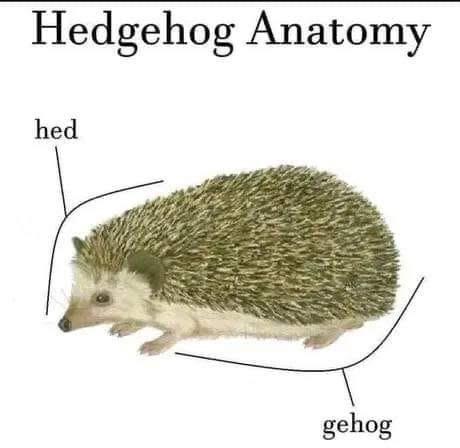
Interesting… Historically the prefix ge- has meant doing something completely. For example, there used to be the verb winnen, which meant “to fight victoriously”. In German it’s nowadays “gewinnen”, constructed from meaning “fighting victoriously all the way until finish”, or more shortly: “to win.” And in English the it has lost the infinite form’s ending “-en”, and is nowadays just “win” (or “to win”).
And then in German a device with -ge in front of its name means it’s assembled out of several parts that somehow function together. So, I’d say based on this that the back three quarters of this … animal? … either technically consists of an amount of hogs, or are several independent components that together form a hog. And do that without having a head.
If you add a he(a)d zu dem Gehog, it becomes a full-fledged animal capable of both locomotion and thought. And spikety-spike-spiky pokey things.
Of course it could also be that “gehog” does not have the prefix “ge” at all, but is instead “geh” + “og”. That would again be German, and would mean “an og that walks”. And an “og” would probably be the same thing as the Dutch “oog” and the German “Auge”: An eye. So, if you take a walking eye and add a hed to it, you get a hedgehog… Ouch.
NEVER DISASSEMBLE A HEDGEHOG!
a.k.a. hedbeholder
deleted by creator